
A new screening tool should facilitate more referrals to sleep medicine.
By Sree Roy
Sleep specialists can increase their role in the early detection of cardiac comorbidities in sleep apnea patients. Sleep Review’s cardiology-sleep solutions column shares new technologies that can help. Email [email protected] with solutions you’d like to see featured here.
Via BRAEBON’s cardiac sleep solutions program, cardiologists have had easy access to BRAEBON’s sleep diagnostic devices for many years. However, BRAEBON founder and CEO Richard A. Bonato, PhD, RPSGT, has found that most cardiologists would rather refer patients to sleep labs than diagnose them with sleep-breathing disorders themselves.
What’s more, like most type III home sleep tests (HSTs), BRAEBON’s MediByte and MediByte Junior have wires, belts, and multiple sensors that clinic staff must understand how to position and explain to patients.
Though these hurdles seem innocuous to sleep specialists, they were just high enough for cardiologists to defer from testing (or even screening) their patients for sleep apnea. “So just over a year ago, we started to say, ‘Let’s revisit that,’” Bonato says.
Key Takeaway: Cardiologists prefer referring patients to sleep labs rather than conducting sleep testing themselves due to the complexity of traditional diagnostic devices.
Another Pulse Oximeter?
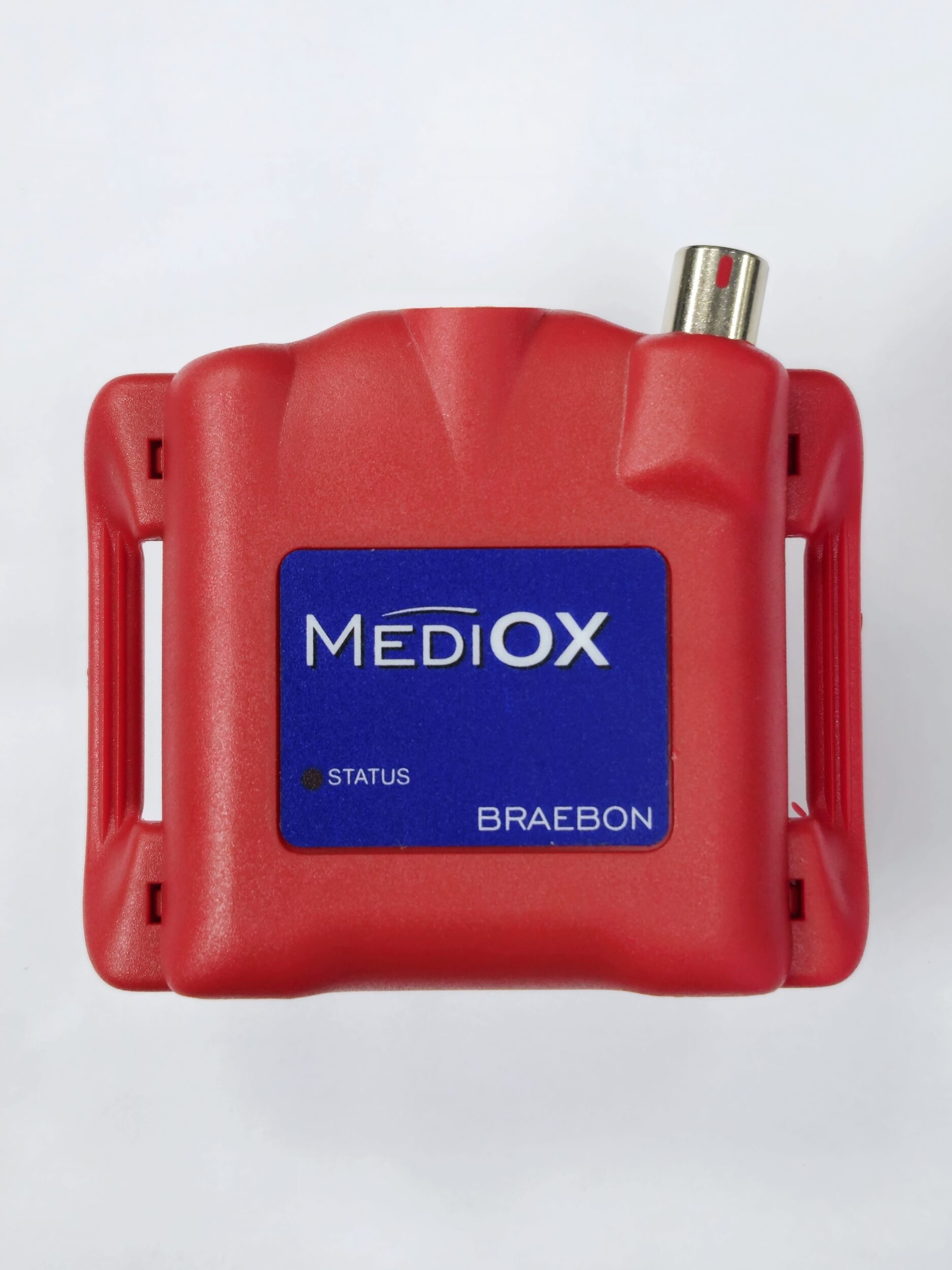
The review resulted in BRAEBON launching a new tool for sleep apnea screening: the MediOX, an easy-to-use pulse oximeter that debuted this spring.
Of course, Bonato concedes, so many pulse oximeter options are available already. But he says MediOX boasts features that make it attractive to cardiologists: It’s worn overnight (going beyond the spot-checking of over-the-counter devices), includes trunk-worn body position reporting, and provides an auto-analyzed report with key metrics related to sleep and cardiac risks.
“Cardiologists are very familiar with pulse oximeters, and this product is well-positioned to give them a solution as a primary screening tool, so they can refer patients to a sleep laboratory with more confidence,” Bonato says.
Key Takeaway: BRAEBON’s new MediOX pulse oximeter offers cardiologists an easy, overnight sleep apnea screening tool with features like body-position recording and auto-generated reports.
MediByte Family Addition
The new MediOX adds to BRAEBON’s MediByte family of devices. It includes the original MediByte, which was Food and Drug Administration cleared in 2006, and the MediByte Junior, in the same housing but with fewer channels. The MediOX is also in the same housing but has even fewer channels.
As the most comprehensive device, the original MediByte also has the most flexibility, including the ability to record single-lead overnight electrocardiogram, both abdominal and chest effort, and electromyography for sleep bruxism or, if placed on a leg, for periodic limb movements.
MediByte Junior was next revealed as a type III HST, but simpler. It has one less airflow (no thermistor), one less belt, and is without an auxiliary port for electrodes or a microphone than the original design.
With the launch of MediOX, BRAEBON now adds its simplest device yet, which Bonato has described as “a very comprehensive pulse oximeter that’s simply screening patients, ideal for a cardiology approach.”
Key Takeaway: BRAEBON’s new MediOX, its simplest screening device yet, expands the MediByte family by offering cardiologists a streamlined pulse oximetry solution for sleep apnea screening.
Calculating Hypoxic Burden
The comprehensiveness Bonato alludes to is due to MediOX’s compatibility with BRAEBON’s long-standing EasyHST software. “All the sophistication is going to be in the existing software that we’ve had for MediByte, which is now pared down,” he says.
The software provides MediOX reports with the oxygen desaturation index, oximetry tables, pulse rate variability, time in different body positions, SPO2 graphs, and, as a nod to cardiologists, the hypoxic burden index. “The problem with the AHI [apnea-hypopnea index] is it doesn’t correlate so well with cardiac risk. Hypoxic burden correlates much better,” Bonato says, adding that the company is also introducing hypoxic burden into MediByte Junior reports.
Auto-calculating the hypoxic burden index (HBI) is a huge time-saver, says Michael Sauve, BSc, RPSGT, a clinical sleep technologist at BRAEBON. He would know: He manually calculated the HBI on hundreds of MediOX studies to validate the software’s automated calculations.
“I had to extract all of the desaturations and put them all in Excel spreadsheets,” Sauve says, just for the first step of calculating the totals, lengths, and percents. This is much more time-consuming than manually determining AHI, where “you can just manually count them and divide by the total sleep time,” he says.
Sauve is optimistic that adding MediOX as a new tool will sway more cardiologists to screen their patient populations for sleep apnea. “Patients can easily go home and hook themselves up with the MediOX,” he says. “The ease of use is very, very good.”
Key Takeaway: BRAEBON’s MediOX leverages EasyHST software to auto-calculate the hypoxic burden index, providing cardiologists an easier and more relevant tool for assessing cardiac risks associated with sleep apnea.