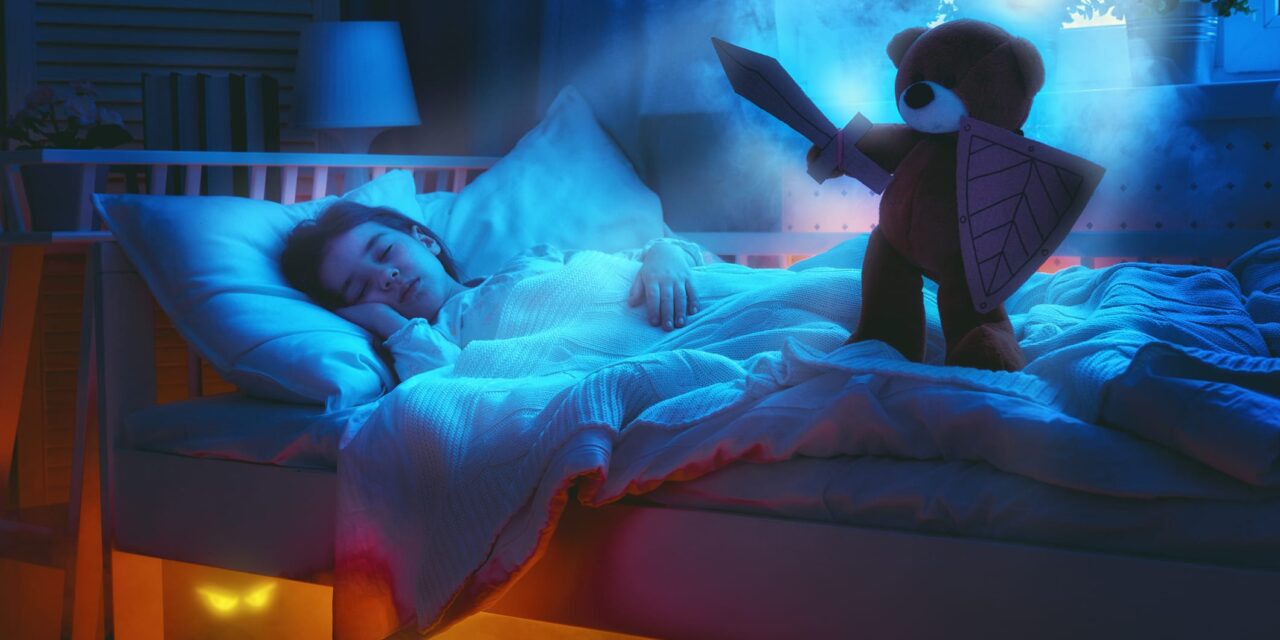
A mastery-based cognitive-behavioral model centers on “nightmare efficacy” to help clinicians create personalized treatment plans for youth.
Key takeaways:
- The DARC-NESS model identifies the cognitive, emotional, and behavioral factors that keep children stuck in a cycle of chronic nightmares.
- At the core of the model is “nightmare efficacy,” the concept that empowering children with skills to manage their dreams can resolve recurrent nightmares and improve overall sleep.
- Treatment is customizable to the patient, ranging from reducing bedtime anxiety and improving sleep habits to exposure-based therapy where children rewrite their nightmares.
Recently published research from the University of Oklahoma and the University of Tulsa proposes a new model to explain why nightmares can persist over time in children and how therapy can be designed to break that cycle.
The study, published in Frontiers in Sleep, introduces the DARC-NESS model, a mnemonic for the factors that can keep a child stuck in chronic nightmares: dream content, appraisals, resources for regulation, conditioned arousal, nightmare efficacy, sleep hygiene and patterns, and sleep quality and quantity. At the center of the model is “nightmare efficacy,” or the idea that children can learn skills to rid themselves of nightmares and restore good sleep.
“The DARC-NESS model looks at the mechanisms of what is maintaining nightmares, as well as the mechanisms that can break the cycle of nightmares,” says Lisa Cromer, PhD, a professor of psychology at the University of Tulsa and a volunteer child psychiatry faculty member at the OU School of Community Medicine in Tulsa, in a release. “It’s a child’s response to a nightmare that causes the chronic nightmares to happen, which means if we can learn to respond to nightmares differently, then we can interrupt that cycle. It’s empowering to understand that we can take steps to master our dreams.”
Rather than focusing only on the content of a nightmare, the model encourages clinicians to consider a broader set of factors, including how a child interprets the dream, worries about going to sleep, experiences anxiety at bedtime, and copes after waking.
That information can help guide a personalized treatment plan instead of a one-size-fits-all approach. For some children, treatment may focus on reducing bedtime anxiety. Others may benefit from improving sleep habits or participating in exposure-based therapy, such as describing, writing about, or drawing the nightmare and then working with a clinician to rewrite it.
“We believe we have created a way to conceptualize why nightmares persist and how we can better treat them in kids,” says Tara Buck, MD, a child and adolescent psychiatrist and an associate professor at the OU School of Community Medicine in Tulsa, in a release. “What’s unique about the model is that it’s customizable to what the patient needs, and it focuses on what the patient can control. We look for the potential intervention points and target those in a collaborative way with patients and their families.”
Unlike insomnia, in which people fear they will not sleep, children with chronic nightmares are afraid they will sleep. According to Buck, helping children build confidence in their ability to address nightmares can have benefits far beyond sleep.
“Self-efficacy is at the heart of the model,” says Buck in a release. “When children feel empowered to do something about the nightmares, they begin to see how things are interconnected – because they’re sleeping better, they have more energy, they go to school more consistently, and their parents report improved behavior.”
The model is designed for use by a range of clinicians, including therapists and pediatricians. For many years, health care providers either assumed that nightmares could not be treated or that they would go away if an underlying trauma or mental health condition were addressed. However, the researchers note that is not always the case.
“We’ve worked with children who have been in mental health treatment for a long time and their nightmares are still persistent,” says Buck in a release. “There is a need for a nightmare treatment model to help children when their nightmares are recurrent and distressing.”