‘This supports data-driven treatment adjustments, mitigates limitations of single-night testing, and positions sleep apnea care alongside modern chronic disease management paradigms’
Key takeaways:
- The FDA granted Class II 510(k) clearance to the ProSomnus RPMO2 OSA Device, which combines oral appliance therapy with continuous SpO2 and pulse rate monitoring.
- Validation studies showed high accuracy for the intraoral buccal mucosal oximeter, with no systematic bias across skin pigmentation groups.
- The device’s intraoral design mitigates common oximetry confounders like motion artifacts, ambient light, and melanin interference, enabling clinicians to make data-driven titration decisions.
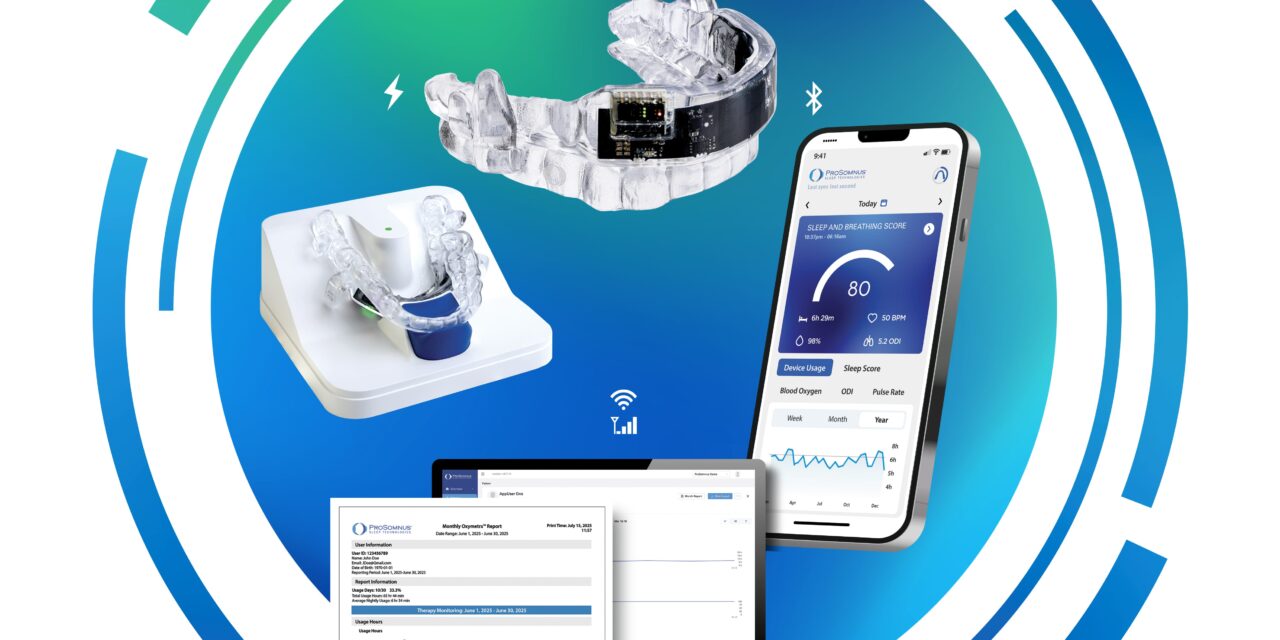
The US Food and Drug Administration (FDA) has granted class II 510(k) clearance for the RPMO2 OSA Device by ProSomnus Sleep Technologies, which incorporates oral appliance therapy and multi-night physiologic monitoring in one device.
The clearance affirms that the device meets FDA standards for safety and effectiveness in measuring oxygen saturation (SpO2) and pulse rate. The device features a wholly embedded oximeter encapsulated in an overlay of the maxillary dentition, using the mucosa of the buccal vestibule behind the upper lip as reflective tissue. Data is transmitted to a provider portal via a patient smartphone app.
“The FDA’s clearance of the RPMO2 OSA Device marks a significant milestone for sleep medicine,” says Len Liptak, CEO of ProSomnus, in a release.
“The RPMO₂ OSA Device represents years of innovation in engineering, human-centric design, and rigorous scientific validation. We set out to create a miniature, highly accurate, comfortable oximeter capable of real-world performance,” says Sung Kim, ProSomnus chief technology officer, in a release.
The FDA clearance is supported by a validation study conducted at the University of Calgary and published by Snow et al in 2025. The study evaluated the accuracy of the intraoral buccal mucosal oximeter against arterial oxyhemoglobin saturation measured using CO oximetry. Enrolling 12 healthy adults with a spectrum of skin pigmentation, participants underwent six controlled hypoxic plateaus spanning approximately 97% to 72% SaO2.
The device demonstrated clinical accuracy across the full range of 70% to 100% SaO2:
- Accuracy Root Mean Square (ARMS) for SpO2: 2.94%
- Correlation between SpO2 and SaO2: r = 0.95
- Bland-Altman: mean bias of 0.72, upper and lower 95% limits of agreement of 6.31 and -4.86, respectively
- Consistent accuracy across entire range of SaO2 tested
The RPMO2 OSA Device also demonstrated pulse rate measurement performance:
- ARMS: 2.08 beats per minute
- Correlation between pulse rate and ECG: r = 0.99
- Bland-Altman: mean bias of 0.30, upper and lower 95% limits of agreement of 4.34 and -3.73, respectively
The study reported no systematic bias across skin pigmentation groups. Because the buccal mucosa is thought to contain less melanin than the epidermis, it may reduce the overestimation of oxygen saturation seen in conventional fingertip devices that measure through melanin-rich tissue.
The intraoral design addresses several limitations of conventional pulse oximeters:
- Motion artifact reduction: Stable placement high in the buccal vestibule minimizes motion-induced noise.
- High perfusion site: The buccal mucosa is richly vascularized, supporting high quality photoplethysmography.
- Thermal stability: The temperature-stable intraoral environment avoids temperature dependent perfusion variability.
- Intrinsic light shielding: The vestibular location protects the sensor from ambient light interference.
- Low melanin interference: Measurement through mucosa may reduce racial bias inherent in skin based oximetry.
“The ProSomnus RPMO2 OSA Device stands to elevate the practice of sleep medicine by simplifying device titration by allowing for the use of robust, objective SpO2 data to guide device titration where previously subjective patient feedback has been used,” says Erin Mosca, PhD, director of scientific and medical affairs at ProSomnus, in a release.
“The ProSomnus RPMO₂ OSA Device gives dental providers a powerful new tool—real-world data that shows how patients are responding night after night,” says Mark Murphy, DDS, D.ABDSM, FAASM, ProSomnus dental sleep medicine director, in a release.
“The ProSomnus RPMO2 OSA Device now offers clinicians the ability to continuously and easily monitor treatment without employing additional diagnostic tools. The implications for managing such a large number of patients are self-evident,” says Adrian Williams, MD, PhD, in a release.
“Clinicians can pair precision oral appliance therapy with continuous, longitudinal physiologic monitoring. This supports data-driven treatment adjustments, mitigates limitations of single-night testing, and positions sleep apnea care alongside modern chronic disease management paradigms,” says Edward Sall, MD, DDS, ProSomnus medical director, in a release.
“The RPMO2 OSA Device provides the potential to more rapidly titrate patients on oral appliance therapy to an effective setting. The ability to monitor oximetry and adherence over multiple nights should allow for more accurate assessments of treatment efficaciousness. In addition, the application of oximetry to the buccal mucosa bypasses concerns of oximetry accuracy on pigmented skin and so should help reduce existing racial disparities in sleep apnea care. I am excited about the potential that RPMO2 has to improve the care of my patients with sleep apnea,” says Sanjay V. Patel, MD, in a release.
“Efficacy of and adherence to interventions in chronic illness are key pillars of disease control and improved outcomes, and OSA is no exception. Hypoxic burden is the underpinning of many OSA-related diseases. Continuous SpO₂ monitoring with ProSomnus RPMO2 uniquely provide a pathophysiologically derived efficacy measure. RPMO2 goes one step forward and provides a measure of adherence that was not available previously. The above makes RPMO2 an important paradigm changing technology in a major intervention for management of OSA,” says Amir Sharafkhaneh, MD, PhD, in a release.
“From preliminary research we have been doing in our clinics, we have found the ProSomnus RPMO2 OSA Device to be very reliable when comparing the physiologic data to that proffered by robust sleep studies, giving us confidence when discussing this new technology with both patients and our referral sources. This not only allows us to monitor treatment success nightly for titration purposes, but we see better compliance as patients love to see how their previous day’s activities influenced the quality of their sleep,” says Kent Smith, D.ABDSM, FAASM, in a release.
“Access to nightly physiologic data with the ProSomnus RPMO2 OSA Device has fundamentally changed how we manage OAT for OSA patients. Instead of relying on snapshot testing or symptoms alone, we can track trends over time, make more precise titration decisions, reduce unnecessary testing, and identify issues earlier—ultimately improving outcomes, patient adherence, and confidence in both the therapy and our clinical recommendations,” says Stacey Layman, DDS, D.ABDSM, D.ABSA, in a release.
“The ProSomnus RPMO2 OSA Device has transformed how I evaluate Oral Appliance Therapy. Multi-night, medically verified data reveals night-to-night variability that one- or two-night titration studies simply miss, enabling truly patient-specific, data-driven treatment decisions. Physician colleagues are consistently impressed by the rigor of the validation, the quality of the data, and the high patient adherence—and prefer their patients treated with therapy supported by this level of objective monitoring,” says Michael J. Murray, DDS, in a release.