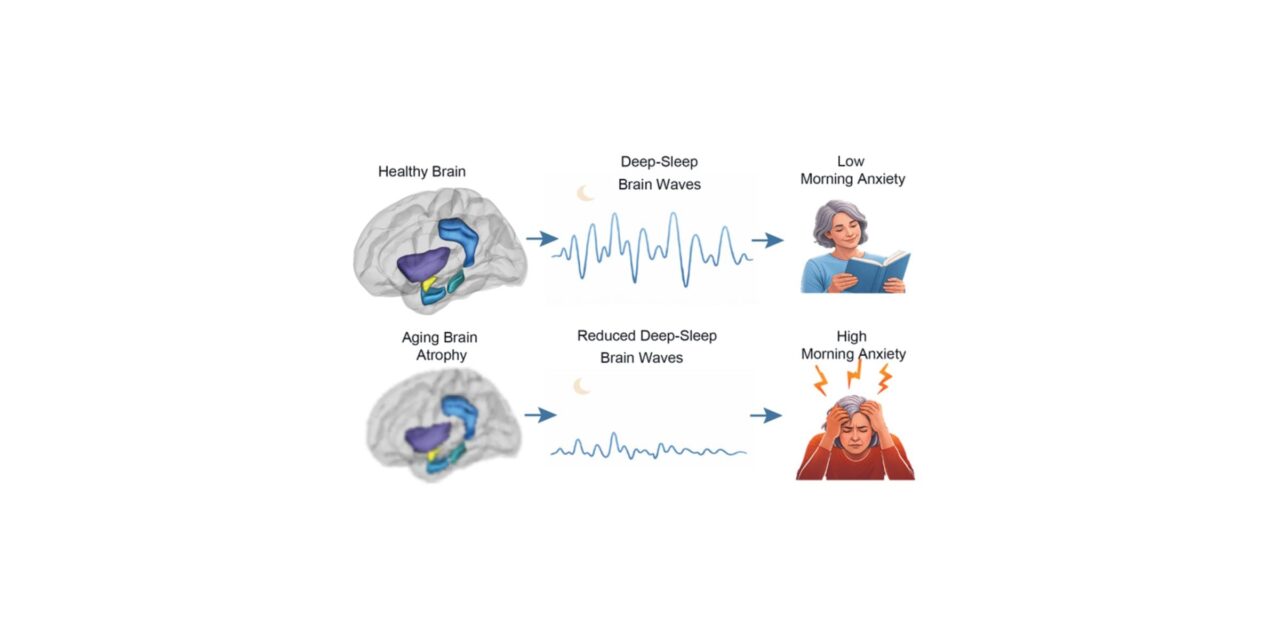
A new study reveals that declining slow-wave sleep impairs overnight emotional regulation, pointing to a modifiable target for late-life anxiety.
Key takeaways:
- A new study links declining slow-wave activity during non-REM sleep to increased next-day anxiety in older adults.
- Researchers found that brain atrophy impairs the capacity to generate deep sleep, which in turn drives anxiety, rather than structural brain changes causing anxiety directly.
- Longitudinal data showed a roughly 20% decline in slow-wave activity over four years, corresponding with increased self-reported anxiety.
- The findings suggest deep sleep is a modifiable target for intervention, with researchers planning to explore acoustic stimulation to enhance slow-wave activity.
Researchers at the Center for BrainHealth at The University of Texas at Dallas have identified a specific feature of sleep that helps older adults regulate anxiety overnight, showing that as it deteriorates with age, emotional well-being deteriorates along with it.
The feature is slow-wave activity: the large, rolling brain oscillations of deep non-REM sleep. In a study published in Nature Communications Psychology, the team found that older adults who generated fewer slow waves during the night woke up more anxious the next morning. Those who maintained stronger slow-wave sleep did not show the same pattern, regardless of their chronological age.
“Deep sleep acts as a kind of nightly recalibration for the anxious brain. When that recalibration is impaired, anxiety doesn’t fully resolve overnight,” says lead author Eti Ben Simon, PhD, associate director of the Sleep Innovation Laboratories at Center for BrainHealth and research assistant professor at UT Dallas, in a release. “The encouraging part is that sleep is modifiable in ways that brain structure is not, offering a powerful lever to help the aging brain continue to adapt and thrive.”
Anxiety disorders are the most prevalent mental health condition among adults over 60, yet they often receive less clinical attention than conditions like dementia or depression. Late-life anxiety accelerates cognitive decline, increases dementia risk, and is associated with an earlier loss of independence.
“The stakes here are real,” says senior author Matthew Walker, PhD, director of the sleep innovation laboratories, Laurie and Todd Platt Chair in BrainHealth and professor of neuroscience and biomedical engineering at UT Dallas, in a release. “As a society, our brainspans are not keeping up with our extended lifespans, but research continues to reveal new avenues that we can influence to proactively improve and optimize our brain health—including sleep.”
The research team studied 61 cognitively healthy older adults from the UC Berkeley Aging Cohort, with a mean age of 74.6 years. Participants spent a night in a sleep laboratory, where brain activity was recorded via polysomnography. They reported anxiety levels before sleep and again the following morning, and underwent a high-resolution MRI scan. A subset of 24 participants returned approximately four years later for a repeat assessment.
Participants with greater shrinkage in key emotional regulatory regions—the amygdala, insula, and cingulate cortex—generated fewer slow waves. A mediation analysis showed that impaired slow-wave activity fully accounted for the relationship between brain atrophy and next-day anxiety. Notably, REM sleep did not show the same predictive relationship.
“The brain atrophy is not directly causing the anxiety,” says Walker in a release. “It impairs the brain’s capacity to generate deep sleep, and it is that sleep impairment that drives the anxiety. This distinction matters because it points to a target that is more amenable to intervention than structural brain change. The atrophy is upstream—it’s the power cut, not the darkness itself.”
Longitudinal data from the four-year follow-up showed a measurable decline in slow-wave activity—roughly 20% fewer slow waves on average—and self-reported anxiety increased correspondingly over the same period. However, meaningful individual variation suggested that chronological age alone was not a reliable predictor of emotional outcomes.
The researchers propose two complementary pathways through which slow-wave sleep supports emotional regulation. First, deep sleep is associated with a shift in autonomic activity from sympathetic arousal toward parasympathetic recovery, reducing next-day stress reactivity. Second, declining slow-wave activity may reflect the deterioration of the locus coeruleus, a brainstem structure responsible for producing noradrenaline that begins to degrade around the same time slow-wave sleep starts to decline.
While the findings describe a vulnerability in the aging brain, they also identify a potential point of intervention. The team is now designing intervention studies to test whether acoustic stimulation—precisely timed audio cues delivered during slow-wave sleep—can enhance slow-wave activity and reduce next-day anxiety in older adults. They are also examining whether preserving slow-wave activity over time is associated with a slower rate of progression from normal aging to mild cognitive impairment.
Read Next:
Top image: A new study shows how brain aging impairs the generation of slow wave activity during sleep, leading to elevated anxiety the next day. Graphic courtesy of Eti Ben Simon