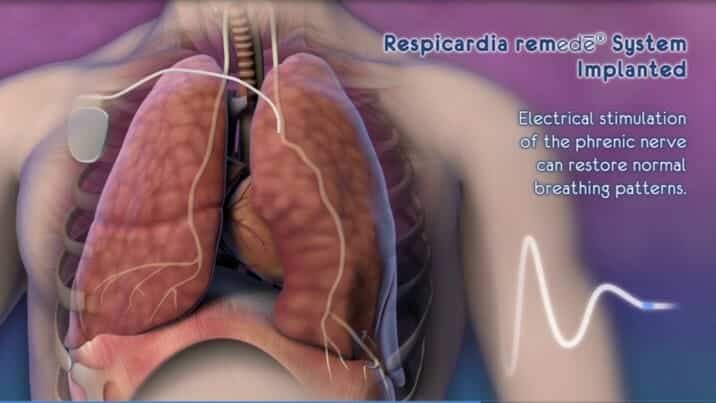
Remedē is implanted under the skin in the upper chest and stimulates the phrenic nerve to regulate breathing.
Summary: Allegheny Health Network has implanted the remedē device, a pacemaker-like system for treating central sleep apnea. The device, which stimulates the diaphragm with electrical currents to restore normal breathing, offers an alternative to CPAP systems. Implanted by a cardiac electrophysiologist, remedē has shown to improve patients’ quality of life and reduce daytime sleepiness in a clinical study. This collaboration between the Allegheny Health Network Sleep Medicine Center and Cardiovascular Institute aims to address the overlap of sleep apnea with cardiovascular conditions effectively.
Key Takeaways:
- Allegheny Health Network has implanted the remedē device, designed to treat central sleep apnea by stimulating the diaphragm to maintain regular breathing patterns.
- The remedē device provides an alternative treatment to continuous positive airway pressure (CPAP) systems, potentially eliminating the need for the uncomfortable masks associated with traditional sleep apnea treatments.
- In clinical trials, the remedē device was shown to significantly improve the quality of life for patients, reducing daytime sleepiness and decreasing the frequency of sleep apnea events.
Allegheny Health Network has introduced the remedē implant, a pacemaker-like device that works to restore restful sleep for adult patients with central sleep apnea.
The company says it is the first health system in western Pennsylvania to implant the device. The therapy was made possible through a collaboration between the Allegheny Health Network Sleep Medicine Center and the Allegheny Health Network Cardiovascular Institute.
The remedē device, which stimulates normal breathing rhythms with small electrical currents to the diaphragm, can also mitigate the need for continuous positive airway pressure (CPAP) systems and the masks that come with them.
George Shaw, MD, cardiac electrophysiologist, and Daniel Shade, MD, pulmonologist, sleep medicine specialist, and director of the Allegheny Health Network Sleep Disorders Center, oversaw the first implant at Pittsburgh’s Allegheny General Hospital in December 2023.
“Unlike obstructive sleep apnea, which is caused by airflow blockage in the upper airway, central sleep apnea occurs when the brain fails to send signals to the diaphragm, disrupting regular breathing. This can manifest as deep and rapid breathing or slow and shallow breathing,” says Shade in a release. “In severe cases, breathing may stop for up to 90 seconds, triggering the body’s fight-or-flight response, which then affects the cardiovascular system.”
Implications for Cardiovascular Health
Central sleep apnea disrupts normal breathing resulting in nighttime wakefulness and increased activation of the body’s sympathetic nervous system, which can lead to increased stress on the heart and impaired function of the cardiovascular system. As a result, central sleep apnea may contribute to the progression of cardiovascular disorders and is often seen in patients diagnosed with heart failure.
“The effects of central sleep apnea and heart failure are connected and require a multidisciplinary approach to improve outcomes and the quality of life for these patients,” says Shaw in a release. “In fact, central sleep apnea occurs in roughly one out of every three patients diagnosed with heart failure and has shown to be an independent predictor of mortality within this patient population.”
For the approximately 75% of patients who have heart failure and/or atrial fibrillation, central sleep apnea events significantly worsen their cardiovascular disease and contribute to a downward cycle of heart failure, leading to higher mortality and hospitalization rates.
Treatment Technology
The remedē device is implanted by a cardiac electrophysiologist during a minimally invasive outpatient procedure. This battery-powered system, positioned under the skin in the upper chest area, employs a thin lead to sense breathing patterns and administer stimulation therapy.
During sleep, the remedē system stimulates a nerve in the chest called the phrenic nerve that in turn sends signals to the diaphragm, the large muscle that controls breathing.
Unlike devices used for obstructive sleep apnea, which focus on opening obstructed airways, the remedē device targets the regulation of breathing in central sleep apnea patients.
Similar pacemaker-like devices on the market instead stimulate a nerve at the base of the tongue to open the upper airward for obstructive sleep apnea. In central sleep apnea, patient airways are already open, but the diaphragm must be stimulated to regulate breathing.
“This groundbreaking system has been clinically proven to improve a patient’s quality of life, reduce daytime sleepiness, and minimize the overall number of disrupted breathing events,” says Shade in a release.
Effectiveness in Treating Central Sleep Apnea
In a study published by cardiologists and clinical researchers in the Journal of Cardiology, phrenic nerve stimulation was shown to be beneficial for those diagnosed with central sleep apnea.
Over 12 months, researchers evaluated 151 patients with moderate to severe central sleep apnea as part of a randomized, controlled trial. All participants received a remedē implant, with only half of the devices activated for treatment within the first six months. Within the treatment cohort, 88% of patients had a reduction in the number of sleep apnea events and 78% of patients reported an overall improvement in the quality of life as well as a significant reduction in daytime sleepiness.
“Diagnosing central sleep apnea in heart failure patients is challenging due to subtle symptoms that overlap with co-existing conditions like fatigue. Collaboration with sleep medicine physicians enables efficient identification of potential candidates for sleep studies, helping to determine the primary causes of sleep disturbances and guiding tailored therapeutic approaches,” says Shaw in a release.
Alternative to CPAP Therapy
Patients with central sleep apnea are often prescribed a CPAP device which includes an external mask that’s often uncomfortable and not well tolerated by patients. As a result, it’s not worn consistently over time. The remedē system can help eliminate the need for CPAP therapy.
Remedē, from ZOLL Respicardia, first received US Food and Drug Administration approval in 2017 for adults with moderate to severe central sleep apnea. The device is covered by most major insurance carriers.