

FAIR Health data shows national telehealth claim volume increased in November 2025, with sleep disorders ranking fifth among diagnostic categories.
Key takeaways:
- Telehealth claim volume increased 3.6% nationally in November 2025 compared to the previous month.
- Sleep disorders returned to the top five national diagnostic categories after falling off the list in October.
- Despite reentering the top five, the share of patients with sleep disorder claims decreased 2.7%.
- Mental health conditions remained the leading telehealth diagnosis nationally and in every region.
Telehealth usage increased nationally and in every US region in November 2025, a month that saw sleep disorders return to the list of the top five national telehealth diagnostic categories.
According to FAIR Health’s Monthly Telehealth Regional Tracker, sleep disorders ranked as the fifth most commonly used diagnostic category in November. This marks a return to the top five after the category fell off the list in October 2025. Despite the higher ranking, the actual share of patients with sleep disorder claims decreased 2.7% during the month.
Regionally, the sleep disorders category fell from second to fourth position in the Midwest. It was not ranked among the top five in the Northeast, South, or West regions in November.
National Telehealth Increases
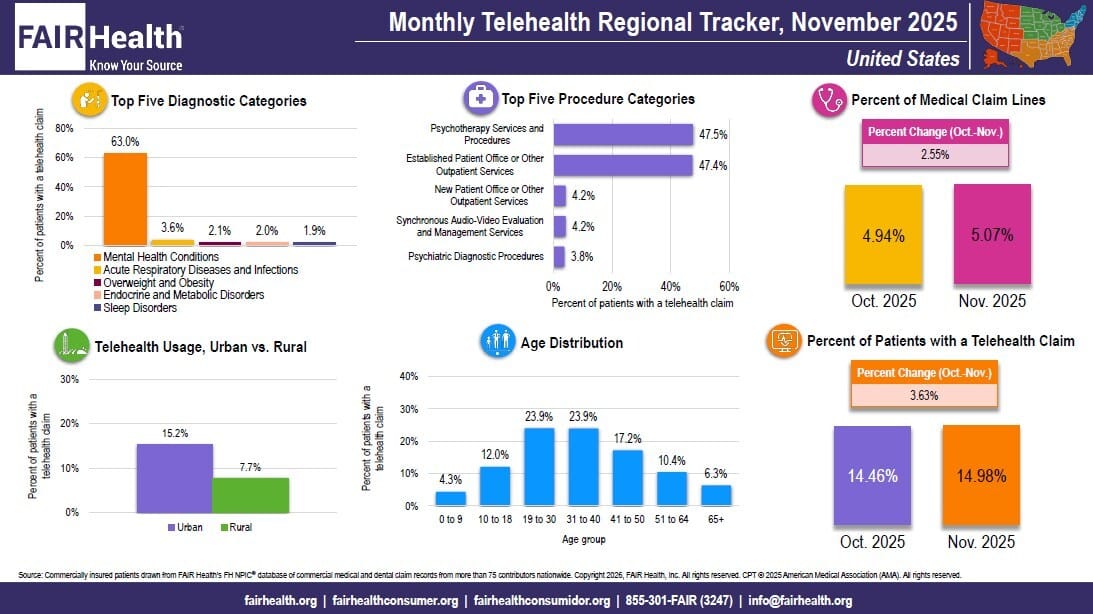
The data, which represents the commercially insured population excluding Medicare and Medicaid, indicates a broad rise in telehealth adoption for the month. Nationally, the percentage of patients with a telehealth claim rose from 14.5% in October to 15.0% in November, a 3.6% increase.
Every region reported growth in claim volume:
- Midwest: 5.1% increase
- Northeast: 4.1% increase
- South: 3.8% increase
- West: 3.7% increase
Telehealth utilization, measured by claim lines, also grew. Nationally, telehealth claim lines rose from 4.9% of all medical claim lines in October to 5.1% in November.
Diagnostic Trends and Demographics
While sleep disorders reentered the national rankings, mental health conditions continued to dominate telehealth usage. In November, patients with a mental health condition accounted for the largest percentage of telehealth claims nationally (63.0%) and in every region. However, this percentage represented a decrease from 63.9% in October.
The data also highlights a continued disparity between urban and rural utilization. Nationally, 15.2% of patients in urban areas had a telehealth claim compared to 7.7% in rural areas. The West showed the widest gap, where urban utilization (19.5%) was more than double that of rural utilization (8.3%).
Regarding age distribution, the 19-30 age group followed by the 31-40 age group represented the highest proportion of patients with telehealth claims nationally. Conversely, the 0-9 and 65 and older age groups had the lowest proportions, with less than 10% of patients in these demographics having a telehealth claim in all areas.
Psychotherapy services and established patient office visits remained the top two procedure categories nationally.