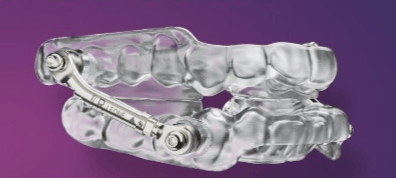
The use of resin aims to improve scalability and reduce manufacturing costs.
Key takeaways:
- The Kava Herbst 3D is a new digital, resin-based 3D-printed Herbst appliance that meets Medicare PDAC E0486 requirements.
- The device utilizes resins rather than traditional acrylics, milled materials, or nylon SLS technology to improve manufacturing scalability and precision.
- Apex Dental Sleep Lab developed the appliance to help mitigate the financial pressures dentists and labs face from lower Medicare reimbursements and rising production costs.
Apex Dental Sleep Lab has received Medicare approval for the Kava Herbst 3D, a custom-fabricated oral appliance FDA 510(k) cleared for mild to moderate obstructive sleep apnea in adults. It is 3D printed from resin. Kava Herbst 3D received Pricing, Data Analysis, and Coding (PDAC) verification under HCPCS code E0486.
E0486 oral appliances are typically fabricated using acrylics, milled materials, or nylon selective laser sintering technology, according to Sonnie Bocala, president of Apex Dental Sleep Lab. The Kava Herbst 3D introduces 3D-resin printing using high-performance dental resins. This fully digital manufacturing approach allows for greater precision, repeatability, and scalability compared to analog or subtractive workflows, streamlining production while maintaining the durability and clinical function expected of a Herbst-style device, Bocala posits.
“This project was really born out of necessity from patients, dentists, and dental labs,” Bocala says. “As Medicare reimbursement continues to compress margins for dentists, it creates downstream price sensitivity in appliance selection, while labs are facing rising manufacturing costs. That pressure pushed me to explore 3D resin printing as a way to improve scalability and efficiency. We didn’t set out to reinvent the E0486 Herbst—just to make it a more viable solution for patients, dentists, and labs.”
The Kava Herbst 3D, which is made in the United States, received its PDAC coding verification following a formal review by Palmetto GBA, confirming it meets the established criteria for the E0486 classification. Medicare defines E0486 as a custom-fabricated oral device used to reduce upper airway collapsibility, adjustable or non-adjustable, which includes fitting and adjustment.
“From a reimbursement standpoint, having a device properly classified under E0486 is critical,” Bocala says. “It creates a clearer pathway for providers to deliver therapy while maintaining financial viability. Our goal was to align innovation with a structure that supports both access to care and sustainability for dental practices and labs.”