The BIDSleep app and a new AI model use heart rate data to offer an alternative to lab-based studies for monitoring sleep patterns.
Key takeaways:
- A new app, BIDSleep, and a corresponding AI model turn consumer Apple Watches into sleep stage monitoring tools for research.
- The system is presented as a convenient, effective alternative to lab-based or at-home sleep study equipment.
- In testing, the AI model accurately identified the correct sleep stage 71% of the time and was particularly effective at identifying deep sleep.
- The technology enables multi-night, at-home data collection, including unplanned naps.
- The AI model is available to other researchers, and the app is designed for easy data portability for clinical and research use.
Researchers at the University of Massachusetts Amherst have developed an app and artificial intelligence (AI) model that uses a consumer Apple Watch for sleep stage monitoring, offering an alternative to traditional sleep study equipment.
The research, published in IEEE Transactions on Biomedical Engineering, details a system designed to provide a more convenient and less expensive method for long-term sleep monitoring in a home environment.
“Our goal was to get as rugged as possible with a non-specialized consumer wearable device, which is the Apple Watch,” says Joyita Dutta, PhD, a professor of biomedical engineering at the University of Massachusetts Amherst and senior author of the research, in a release. She envisions researchers can use the app to monitor people with sleep disorders at home, without costly lab-based sleep studies.
The system was developed for Dutta’s research into the connection between sleep disruptions and Alzheimer’s disease. Lab-based sleep studies are often limited to a single night due to cost and complexity, and current technology struggles to capture data from unplanned naps. The round-the-clock wearability of a smartwatch addresses these limitations.
The app, called BIDSleep, collects data on instantaneous heart rate, which varies depending on the sleep stage. These data are then processed by the team’s new AI model. On average, the model accurately identified the correct sleep stage 71% of the time. According to Dutta, the model is even more accurate at identifying deep sleep, which is significant as aging is associated with a more pronounced decline in deep sleep.
“Overall accuracy matters, but sometimes we also need to look at the clinical metrics like sleep efficiency and sleep onset latency, total sleep time,” adds Tzu-An Song, a postdoctoral research fellow in Dutta’s lab and first author on the paper. The AI model produced results for these clinical parameters that were closer to the gold standard of EEG-based sleep staging compared to other modeling approaches. “Our method works better for basically all of these metrics,” he says.
The researchers note they did not compare their technology to the Apple Watch’s native sleep-staging capabilities, which were not available at the time of their study, but they plan a future head-to-head comparison. They anticipate their app may be more accurate because it collects heart rate information at a denser rate than the native Apple Health features.
“Ultimately, we’d love for researchers and clinicians to use this app, which is why we created it in a style where you can easily port the data and get multi-night information out of it,” says Dutta.
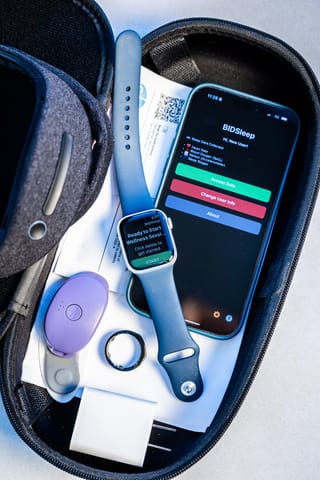
BIDSleep, an app developed by Joyita Dutta’s Biomedical Imaging and Data Science Lab, collects data for studying sleep, turning an Apple Watch into an accessible alternative to other monitoring devices, such as the ones shown here. Credit: Derrick Zellmann