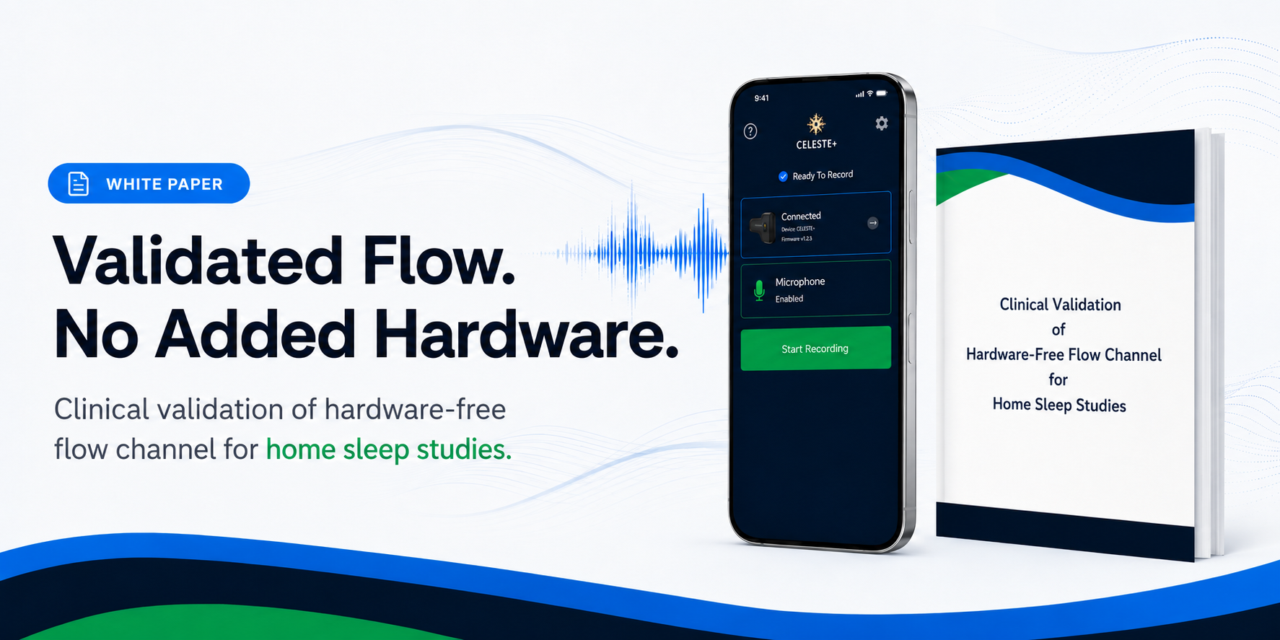
EnsoData’s latest white paper examines the clinical validation of its hardware-free flow channel, which uses smartphone-recorded breathing sounds to support respiratory flow data in home sleep studies.
The white paper reviews how EnsoData’s flow modality compares with PSG nasal pressure, including signal comparisons, clinician-scored AHI agreement, and event depth analysis across respiratory event types.
A Hardware-Free Approach to Respiratory Flow
Sleep-disordered breathing remains widely underdiagnosed, in part because traditional polysomnography can be costly, complex, and difficult for patients to access.
EnsoData’s hardware-free flow channel is designed to help reduce that barrier. Using the Celeste+ smartphone application, breathing sounds are captured through the phone’s built-in microphone and analyzed to create an independent respiratory flow channel—without new sensors, wires, or additional clinical setup.
What the Clinical Validation Evaluated
The white paper presents validation data from 62 simultaneously recorded PSG Type I and EnsoData flow studies. The analysis compares EnsoData’s flow modality with PSG nasal pressure through:
- Side-by-side signal comparisons
- Clinician-scored AHI agreement
- Obstructive Respiratory Index and Central Respiratory Index comparisons
- Event depth analysis for obstructive and central respiratory events
Together, these results help demonstrate how smartphone-recorded breathing sounds can support a clinically meaningful respiratory flow signal for home sleep study workflows.
Key Findings from the White Paper
The validation results showed strong agreement between EnsoData’s flow channel and PSG nasal pressure. Across the 62 studies, clinician scoring produced a mean AHI difference of 0.88 respiratory events per hour, along with comparable ORI and CRI results. The white paper also reports 92% accuracy at AHI ≥5 and AHI ≥15 severity thresholds, with perfect agreement at the AHI ≥30 threshold.
Event depth analysis further showed that EnsoData’s flow channel tracked airflow reduction patterns across obstructive and central respiratory events, supporting its use as a practical, clinically meaningful flow modality for home sleep studies.
Why This Matters for Sleep Professionals
Home sleep testing continues to play an important role in expanding access to sleep diagnostics. But equipment logistics, patient setup, and workflow burden can still create friction.
By using the smartphone patients already have, EnsoData’s hardware-free flow channel is designed to fit naturally into existing sleep study workflows while reducing the need for additional proprietary equipment. The result is a simpler, reusable, and clinically validated approach to capturing respiratory flow data in the home setting.
Inside the white paper, you’ll find:
- How EnsoData’s hardware-free flow channel works
- Validation data from 62 simultaneous PSG Type I and flow studies
- Signal comparisons with PSG nasal pressure
- Clinician-scored AHI, ORI, and CRI agreement analysis
- Event depth comparisons for obstructive and central respiratory events
- Key takeaways for home sleep study workflows
Sponsored by

Medqor is committed to protecting and respecting your privacy. We may contact you about our products and services or share information with sponsorship partners, as well as other content that may be of interest to you. By submitting your information, you consent to us contacting you for this purpose in accordance with our privacy policy.
For further information, please check out our privacy policy here