

The new platform integrates Wesper Lab and Wesper Lite to offer customized diagnostic pathways and streamline patient management for sleep clinics.
Key takeaways:
- Wesper will introduce a unified ecosystem at SLEEP 2026 that brings its respiratory-based Wesper Lab and PPG-based Wesper Lite tests onto one platform and patient record.
- The system allows clinicians to escalate patients from a high-volume screening study to a high-fidelity diagnostic study without the need for re-onboarding.
- Also at SLEEP, the company is presenting three research posters highlighting autoscoring precision, AI-driven central apnea detection, and positional OSA phenotypes in obese patients that standard AHI misses.
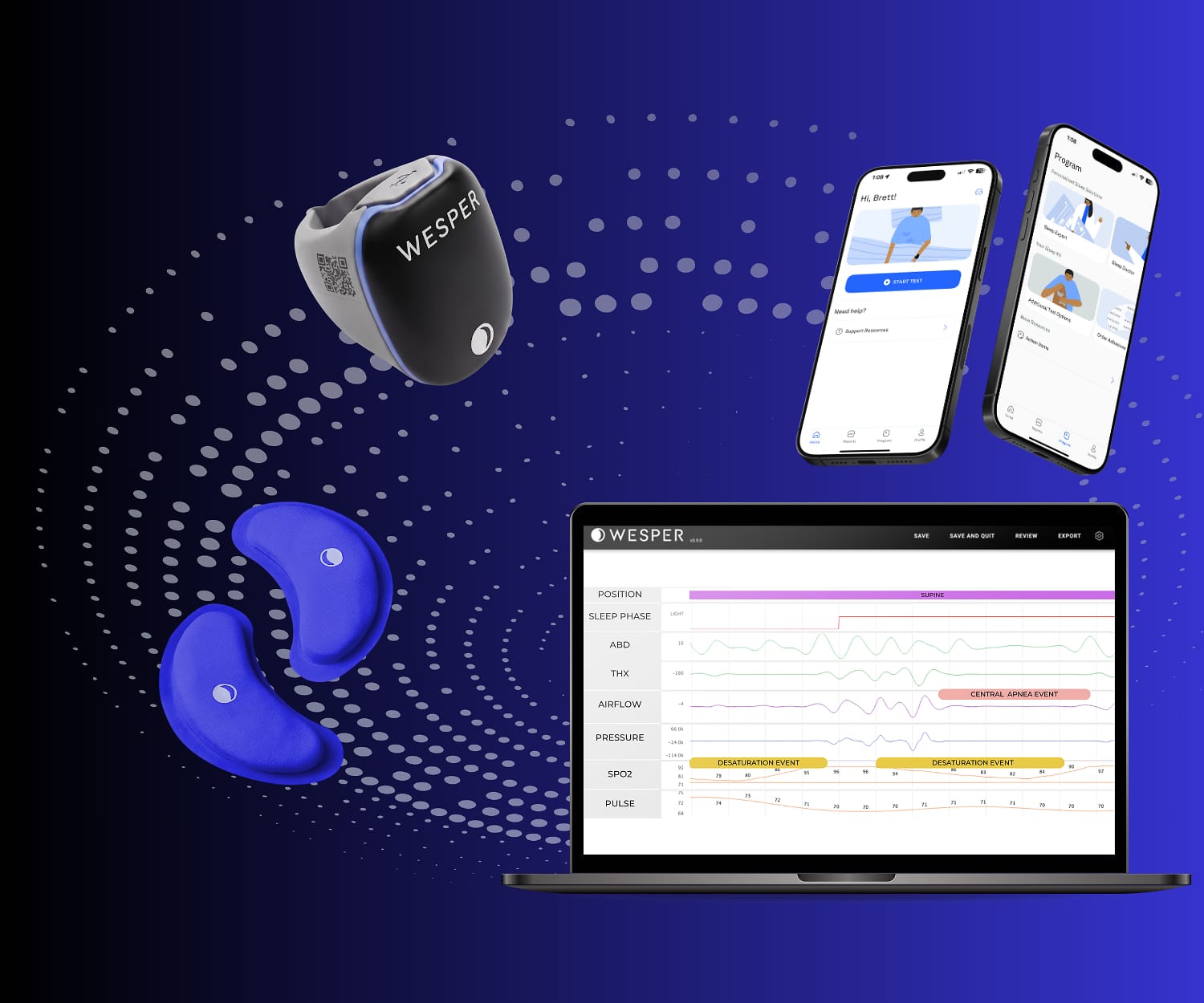
At booth #1007 at SLEEP 2026, Wesper will demo two levels of sleep testing within one ecosystem. The ecosystem brings two diagnostic pathways—Wesper Lab and Wesper Lite (pictured, above)—onto one platform, one patient record, and one interpretation pipeline, allowing physicians to match the right test to the right patient without changing clinic workflows.
Wesper Lab is the company’s high-fidelity, respiratory-based test, built for detailed analysis and ongoing follow-up with cannula-free airflow, positional analysis, and central apnea detection. Wesper Lite is an optical sensor-based (PPG) test designed for general diagnostics, high-volume screening, and remote patient monitoring.
Both testing tiers run on Wesper’s signal analysis capabilities, meaning a Lite study can escalate to a Lab study without re-onboarding the patient.
“Sleep apnea is a complicated condition that presents uniquely in every patient, but existing sleep testing has often been approached as one-size-fits-all,” says Amir Reuveny, PhD, CEO and founder of Wesper, in a release. “With Wesper Lab and Wesper Lite on one ecosystem, physicians can choose the right test for each patient and follow that patient through diagnosis, treatment, and ongoing monitoring on a single record. That is what personalized sleep testing—and ultimately personalized care—looks like.”
Additionally, Wesper is presenting three research posters at SLEEP 2026. These include new data on provider-tuned autoscoring, artificial intelligence-driven central sleep apnea detection validated against PSG, and an underrecognized positional obstructive sleep apnea (OSA) phenotype in obese patients. According to the company, the studies reinforce the clinical depth behind the ecosystem and the value of direct, multi-night respiratory data.