How CPAP mask acoustics have improved to facilitate better sleep for the patient and the oft-overlooked bed partner.
By Sree Roy
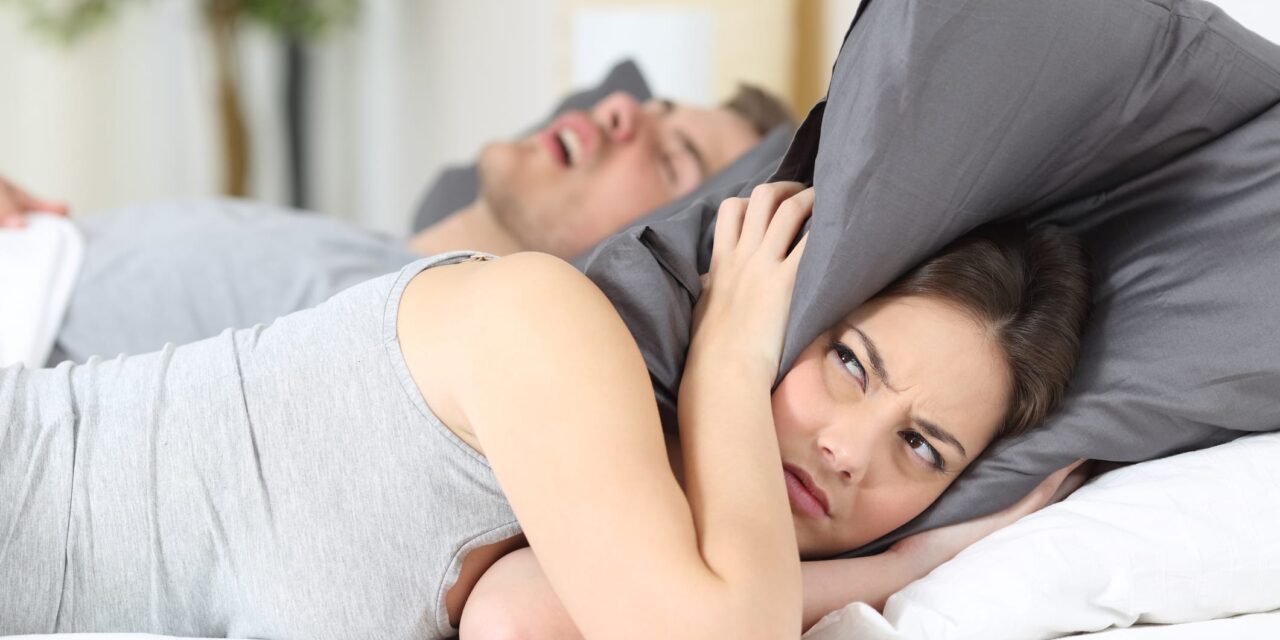
For many, the journey to diagnosis begins with a bed partner’s frustration.
Driven by the disruptive sounds of snoring and the fear of witnessed apneas, bed partners have a reputation for elbowing the undiagnosed sleep apnea patient toward the sleep physician’s office. Yet, a sad irony can emerge once therapy begins: the noise from a CPAP mask can sometimes be as disruptive to the bed partner as the sleep apnea had been.
“When I started at Resmed, this was one of the biggest problems we were solving,” says Charles Hartson, vice president of product management at Resmed. “The bed partner is pushing patients to use it, but then when the patient starts on CPAP, the partner is having this issue where the air just blows back on their face.”
In the last eight to ten years, much has improved in CPAP mask engineering, creating a quieter environment for patients and their bed partners. “One of the things that often frustrates me is how CPAP is represented in popular culture,” Hartson continues. “But I think breaking the perception of how things, like the venting and the noise of CPAP, have come a long way in a short period. It’s going to help us reach the people today who have untreated sleep apnea.”
The Science of Silence
While decibels (dB) are the standard unit of sound, the sleep industry tends to use dBA, or A-weighted decibels. This metric adjusts sound intensity to mimic the human ear’s sensitivity, which is reduced at very low and very high frequencies.
However, Hartson notes that the engineering process involves a much deeper dive into acoustics than the technical specifications on a product brochure might suggest.
“We’re not only looking at the sound power, the sound pressure, and dBA; we’re also looking at the frequency of that sound itself,” Hartson says. He explains that even a “quiet” mask can be disturbing if it emits a frequency that is uncomfortable to the human ear, such as a high-pitched wheeze.
Sound power is the total acoustic energy emitted by a source, independent of its environment. Sound pressure is the local pressure fluctuation at a specific point, which changes based on distance and the environment.
Noise Sources
According to Chris Abad, product manager at Fisher & Paykel Healthcare, noise in a CPAP system is generated from two primary physical sources: the motor and the airflow itself.
The first source is mechanical vibration. “Vibrations coming from the motor driving the centrifugal pump inside the machine” can create resonance, he explains.
A second source is the airflow. ”Room air is drawn into the machine, flows through the pump to get pressurized, and then travels through a winding path to the breathing hose and out through the mask interface,” Abad says. “This causes a lot of turbulent noise being generated, including the noise generated inside the mask and also as it exits the bias flow holes (designed for intentional leak to reduce CO2 rebreathing).”
Normal breathing also emits a sound of about 10 DBA. Hartson says, “All of these sources stack up. We’re looking at the right balance of all those sources, and then optimizing the geometry inside the mask, inside the tube, and inside the device to minimize that sound for our users.”
Diffuser Evolution
A technological solution to vent noise and intentional leak is the diffuser. Early CPAP masks, Harton says, typically utilized “multi-hole vents”—simple groupings of holes on the cushion or frame. While effective at CO2 exhaust, these designs often produced a directed, high-velocity stream of air. “The problem with that is that it just blew air in a very single direction, normally towards the bed partner or back into the bedhead or bed pillow, and created a disturbance,” Hartson says.
The introduction of diffuser technology, such as Resmed’s QuietAir, changed the mechanics of venting. Rather than pushing air directly through a hole, the air enters a diffuser—often a multi-layered material—and disperses across a wider area, taking the edge off the noise. When Resmed transitioned the F20 mask to a diffuser elbow, it became nine times quieter and the exhaled airflow became approximately 70% gentler, Hartson says.
Fisher & Paykel Healthcare utilizes similar principles, employing plastic fiber diffusers in masks like the Eson 2 and Nova Nasal to dampen sound and reduce exhalation draft. Abad notes that the design of these components has evolved from two separate pieces to one for better usability. “It makes it easier for a patient to clean,” he says.
Vent Geometry and Laser Drilling
Manufacturers also rely on precision vent geometry.
Laser drilling allows engineers to create intricate shapes and angles for the bias flow holes that would be difficult to achieve with standard manufacturing techniques, Abad says. By controlling the angle and shape of these holes, they can mitigate both noise and the perceived draft.
Hartson adds that vent geometry is a “key piece” of the tuning process. Engineers must calculate the delta between the holes and the exit space to find the right balance of frequencies and sound power across different mask types and pressures.
Clinical Evaluation of CPAP Mask Noise
In the real world, evaluating “quiet” claims requires more than just reading a spec sheet. Here, a hands-on demonstration is the best way to gauge performance.
Hartson suggests clinicians not only listen to the mask at therapeutic pressures but also feel the vent flow. He says, “What is that experience if someone puts their arm in front of themselves in the middle of the night or tries to sleep close to their bed partner? Does it give them the freedom they want?”
Abad suggests that clinicians try out a sample mask at home to listen to the sound and draft in a real-world environment. “The best experience is to actually try it,” he says.
Troubleshooting: Check Mask Leak First
Modern CPAP masks that are assembled properly and without unintentional leaks should be only a touch louder than “a quiet rural valley or a mountain slope,” Hartson says. “And it should be gentle and quiet, almost a ‘white noise’ type sound.”
But if it’s any louder or “obnoxious,” Hartson says, the first step in troubleshooting should be a search for leaks. A mask that is not sealed properly will produce noise far exceeding its rated decibel level.
Abad recommends triaging the noise by checking the cushion size and ensuring the headgear is not too tight, as over-tightening can actually compromise the seal and increase noise.
The Future of CPAP Acoustics
As technology advances, the focus of acoustic engineering is shifting from merely reducing volume to refining the quality of sound. Hartson believes the future lies in “sound engineering and the power of sound for sleep.”
“I think the future is not just looking at how quiet something is; the future is going to be in continuing to refine the type of sounds that come through and using that sound to the advantage of total sleep performance,” Hartson says.
Who knows? Maybe the sound emissions from next-generation CPAP masks will even optimize the acoustic environment for sleep—a wonderful thought for patients and their bed partners alike.