

Sleep disorders entered the national top five telehealth diagnostic categories in March 2025 in fifth position, according to FAIR Health’s Monthly Telehealth Regional Tracker.
At the national level, the sleep disorders diagnostic category accounted for 1.8% of patients with a telehealth claim. Joint/soft tissue diseases and issues, which had been in fifth position in the national top five in February, rose to fourth, and overweight and obesity, which had been in fourth position in February, dropped off the list in March. In the West, sleep disorders also entered the top five in fifth position, displacing overweight and obesity, which fell off the list there as well. The data represent the commercially insured population, excluding Medicare Fee-for-Service, Medicare Advantage, and Medicaid.
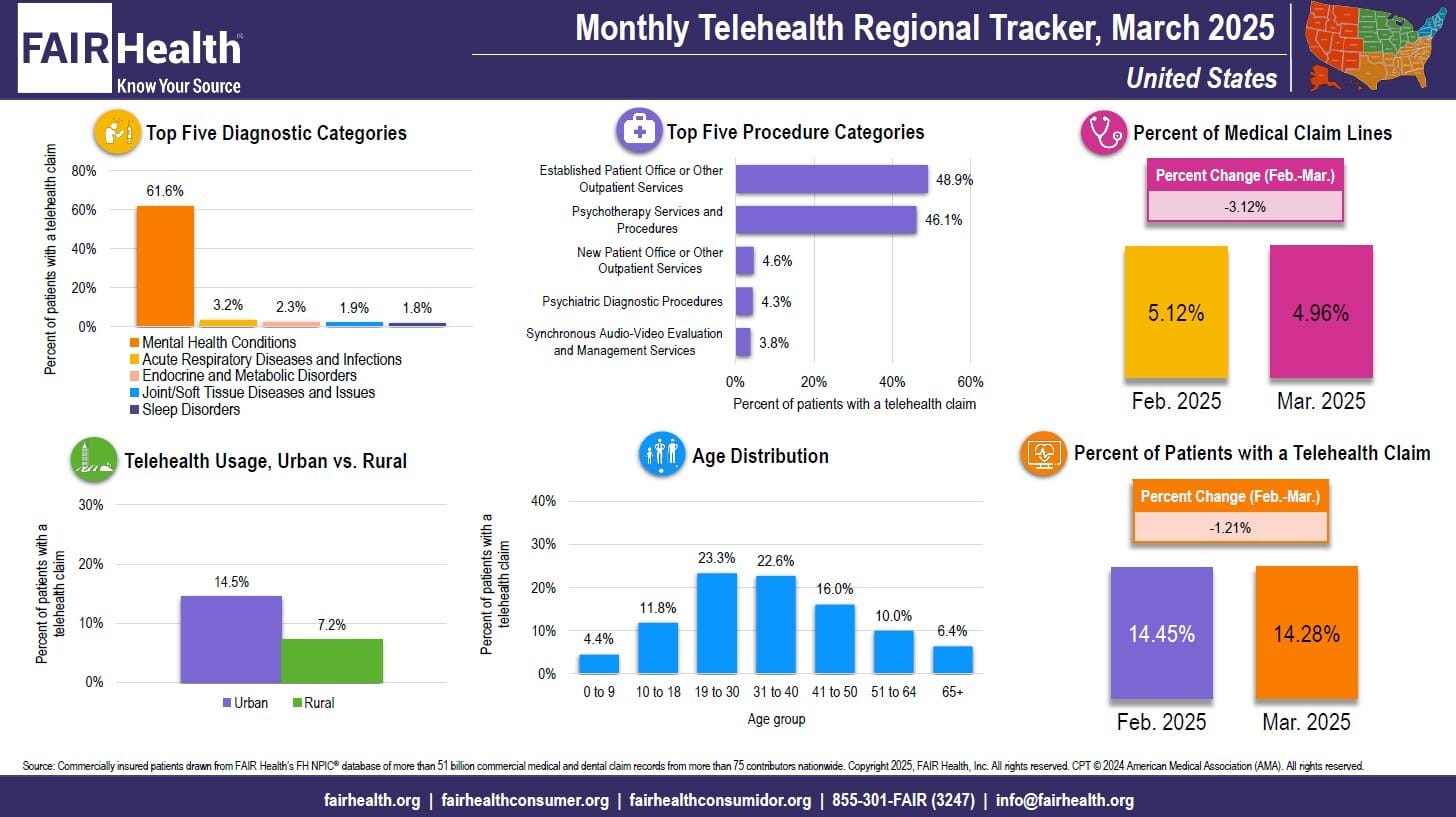
Nationwide, the top 5 telehealth diagnostic categories in March were:
- Mental Health Conditions: 61.6%
- Acute Respiratory Diseases and Infections: 3.2%
- Endocrine and Metabolic Disorders: 2.3%
- Joint/Soft Tissue Diseases and Issues: 1.9%
- Sleep Disorders: 1.8%
Mental health conditions remained the top diagnostic category nationally and in every US census region in March. This category accounted for 61.6% of patients with a telehealth claim nationally, down from 62.3% in February. Regionally, in March, the percentage varied from 68.2% in the Northeast to 55.9% in the South.
Telehealth Utilization
In March 2025, the percentage of patients with a telehealth claim decreased nationally and in every region except the West. Nationally, that percentage decreased from 14.5% of patients in February to 14.3% in March, a 1.2% drop. Regionally, the decreases varied from 0.8% in the Northeast to 2.4% in the Midwest. In the West, however, the percentage of patients with a telehealth claim increased 1.8%.
During the same period, telehealth claim lines (an individual service or procedure listed on an insurance claim) decreased as a percentage of all medical claim lines nationally, in the South and the Midwest, but they increased in the Northeast and West. Nationally, the percentage decreased 3.1%, from 5.1% of claim lines in February to 5.0% in March. In both the South and Midwest, telehealth claim lines decreased 5.2%. The increases were 2.5% in the Northeast and 0.7% in the West.
[Related: Should You Add Telehealth to Your Dental Sleep Medicine Practice?]
Urban Vs Rural
As in February, in March 2025, telehealth utilization was higher in urban than rural areas nationally and in all four regions. Nationally, 14.5% of patients in urban areas used telehealth, compared to 7.2% in rural areas. The largest difference occurred in the South, where the percentage of urban patients using telehealth (12.6%) was 2.3 times the percentage of rural patients (5.4%). The smallest difference was found in the Northeast, where the urban share (16.2%) was 1.5 times the rural share (11.0%).
Age Distribution
As in February, in March 2025, the age groups 19-30 years and 31-40 years accounted for the largest percentages of patients with a telehealth claim nationally and in every region. On the national level, 23.3% of patients in the age group 19-30 had a telehealth claim, and 22.6% of patients in the age group 31-40 had a telehealth claim. Nationally and in every region, the age groups 0-9 and 65 and older accounted for the smallest shares (less than 10% each) of patients with a telehealth claim.
Telehealth Procedures Categories
In March 2025, as in February, the top two procedure categories nationally and in every region were established patient office or other outpatient services, and psychotherapy services and procedures. The order of the two varied by region. Nationally and in the South and West, established patient office or other outpatient services ranked first; in the Midwest and Northeast, psychotherapy services and procedures ranked first. On the national level, established patient office or other outpatient services (including those for mental health conditions) accounted for 48.9% of patients with a telehealth claim (up from 48.1% in February), while psychotherapy services and procedures accounted for 46.1% (down from 47.1%).
The Monthly Telehealth Regional Tracker, which launched in May 2020 as a free service, uses FAIR Health data to track how telehealth is evolving from month to month.
We recommend for you:
ID 189236766 © Attackdk | Dreamstime.com