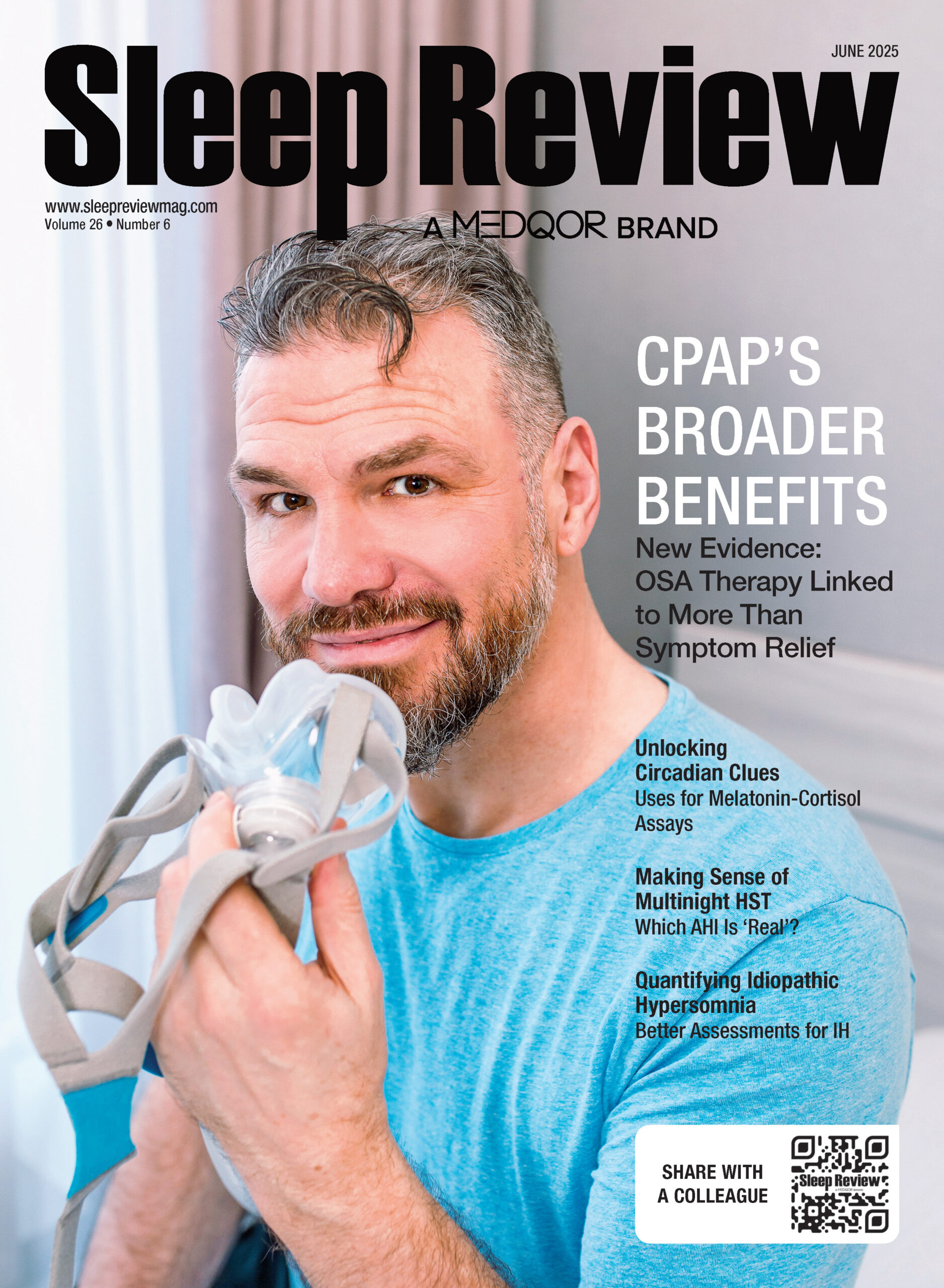
Explore the June 2025 Edition
Get highlights from an analysis of data from over 1 million individuals with OSA , make better sense of multinight sleep testing, learn how to better quantify idiopathic hypersomnia, and more.
The BRPT CSTE will expire on 9/14/26. Take the quiz before then to earn CSTE.
CSTE Exam Preparation Articles
For thorough test preparation, please review these essential articles. They cover key topics and concepts that will be evaluated.
CPAP Linked to Living Longer, Meta-Analysis Finds*
Learning Objectives: Understand that a large meta-analysis published in The Lancet Respiratory Medicine, funded by Resmed, combined data from over one million individuals with OSA and found that CPAP therapy reduced all-cause mortality by 37% and cardiovascular mortality by 55%; Describe the dose-response relationship observed: greater consistency and longer duration of nightly CPAP use were directly correlated with increased survival benefits; Know that even modest nightly CPAP usage—in some prior studies as little as one to two hours per night—was associated with reduced healthcare utilization.
Making Sense of Multinight Home Sleep Testing*
Learning Objectives: Recognize that night-to-night variability in AHI—along with the “first-night effect”—can result in misdiagnosis; Understand that this variability may be even greater in women, with single-night studies showing lower sensitivity for detecting mild OSA, potentially due to greater AHI fluctuations across nights; Recognize that, despite growing adoption, the field lacks published guidelines on how many nights to test, how to interpret differing results across nights, and how to integrate multinight models into current reimbursement and workflow systems.
Quantifying IH Requires More Than Sleep Latency—Here’s What to Try Instead
Learning Objectives: Explain that relying solely on sleep latency (as measured by the MSLT) is insufficient to quantify idiopathic hypersomnia (IH) severity accurately; Identify alternative measurement tools proposed to better capture IH’s complexity; Recognize the rationale for using multidimensional symptom measurement in IH.
How Saliva Testing Helped Me Rethink My Circadian Rhythm*
Learning Objectives: Understand that direct-to-consumer and clinician-available salivary assays for hormones like melatonin, cortisol (and sometimes insulin) provide biological insights into circadian rhythms beyond traditional tools such as actigraphy and sleep diaries; Recognize that these hormone time-lapse profiles—including melatonin onset thresholds—can aid in optimizing sleep timing; Explain the importance of a melatonin washout period before testing.
How the Next Generation of Oral Appliances Could Reshape Treatment
Learning Objectives: Identify that most traditional oral appliances for OSA rely on mandibular advancement alone, which can fail to address multilevel airway obstruction; Explain that some new oral appliances are designed to incorporate additional mechanical actions—such as vertical and lateral jaw movement, tongue stabilization, and nasal dilation—to enhance airway opening efficiency; List several oral appliance makers that are developing these next-generation oral appliances.
Terms for CSTE Qualification
The Board of Registered Polysomnographic Technologists (BRPT) designates this educational activity for a maximum of 0.5 Continuing Sleep Technology Education (CSTE) credits. Individuals should claim only those credits that he/she actually earned in the educational activity. Certificates are issued on Fridays.
To be awarded Continuing Sleep Technology Education (CSTE) credit, BRPT-credential holders must read the digital edition of Sleep Review and score 80% or higher on the post-test. The participant may re-take the post-test up to 3 times. If unable to achieve a passing score, credit cannot be issued.
Questions/comments: Email [email protected]
* Conflict of Interest: Articles are written by employees of Sleep Review, which accepts sleep marketer advertising